
Uncompromising power resilience for mission-critical data facilities.
Data centers demand absolute continuity. AWP enterprise online UPS architecture safeguards high-density server clusters, storage arrays, and core routing infrastructure against critical power anomalies, ensuring zero transfer time and maximum availability.
Engineered for high-availability cloud nodes, colocation facilities, and enterprise server installations.When facility uptime and data integrity are non-negotiable.
Modern data centers operate under immense performance pressure where a millisecond of power disruption can result in catastrophic data corruption or service outages. Double-conversion online topology ensures complete isolation from grid fluctuations and instant battery backup.

High-Density Blades
Support power-hungry blade servers and high-performance computing (HPC) nodes with robust electrical regulation.
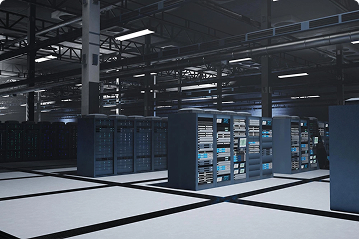
Storage Area Networks
Protect SAN and NAS storage arrays from unexpected dropouts that threaten transactional databases and file repositories.
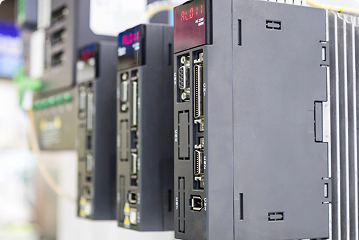
Core Switching Fabrics
Keep core enterprise switches and modular routing chassis online to sustain internal and external network traffic flow.

Redundant Modules
Deploy parallel N+X redundancy configurations to ensure continuous operations even during scheduled maintenance cycles.
Scalable power topology for any facility tier.
Tailor your backup architecture to match your facility scale, from edge server rooms to large-scale modular data hubs.

Edge & Modular Enclosure
For smaller localized server spaces and edge micro-data centers requiring reliable online protection in standard rack formats.

Mid-Market Server Room
For growing corporate server spaces housing multiple production racks, hypervisors, and enterprise database systems.
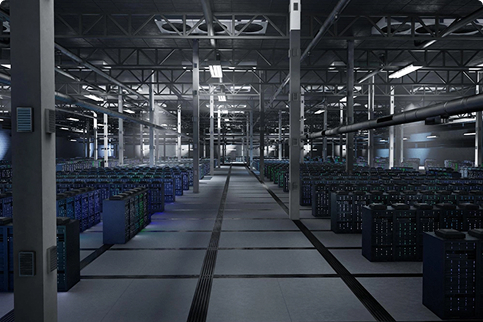
Enterprise Data Center Facility
For multi-rack facilities requiring centralized three-phase power distribution, hot-swappable modules, and enterprise telemetry integration.
Rigorous engineering for data center deployment.
Systematic evaluation of electrical loads and facility constraints ensures maximum reliability and seamless integration into your infrastructure.
-
1
Audit total IT load and power factors
Calculate aggregate kW and kVA requirements across all active server and network racks.
-
2
Determine redundancy requirements
Evaluate whether N, N+1, or 2N fault-tolerant configurations are needed for your SLAs.
-
3
Specify runtime and generator synchronization
Define target backup duration before auxiliary generator kick-in or clean system shutdown.
-
4
Review facility electrical infrastructure
Verify input voltage, phase balancing (single vs. three-phase), and building breaker limits.
-
5
Integrate remote management and monitoring
Establish SNMP/Modbus protocols for centralized data center infrastructure management (DCIM).
Standard configurations for critical server facilities.
Explore proven deployment profiles tailored for enterprise workloads.
High-Density Rack Cluster
Multiple blade servers + high-speed SAN arrays. Requires double-conversion online protection to handle rapid load shifts.
Colocation Server Farm
Mixed tenant infrastructure requiring isolated power feeds, strict phase balancing, and comprehensive metering.
Enterprise Core Routing Hub
Core switches and gateway firewalls requiring zero transfer time and continuous frequency conditioning.
Modular Data Center Unit
Scalable multi-rack setup utilizing hot-swappable power modules for zero downtime during maintenance.
Frequently Asked Questions
Protect your data center and mission-critical workloads.
Tell us about your facility capacity, redundancy requirements, and critical load profiles. We will help you deploy the right AWP high-availability power solution.
Final disclaimer: Recommendations must be confirmed using the specifications of the exact locally available model. A UPS does not replace safe electrical installation or equipment-specific operating requirements.